
Last-mile optimisation starts with modularity
Out-of-home (OOH) delivery isn’t a side channel anymore. It’s infrastructure. And infrastructure sized for today rarely fits tomorrow. Most locker networks are still designed the old way: sized once, fixed forever, then left to either sit half-empty or choke on volume they were never built to carry.
Punta built its hardware around a different premise. A locker installation should be able to change shape as fast as the market around it does.
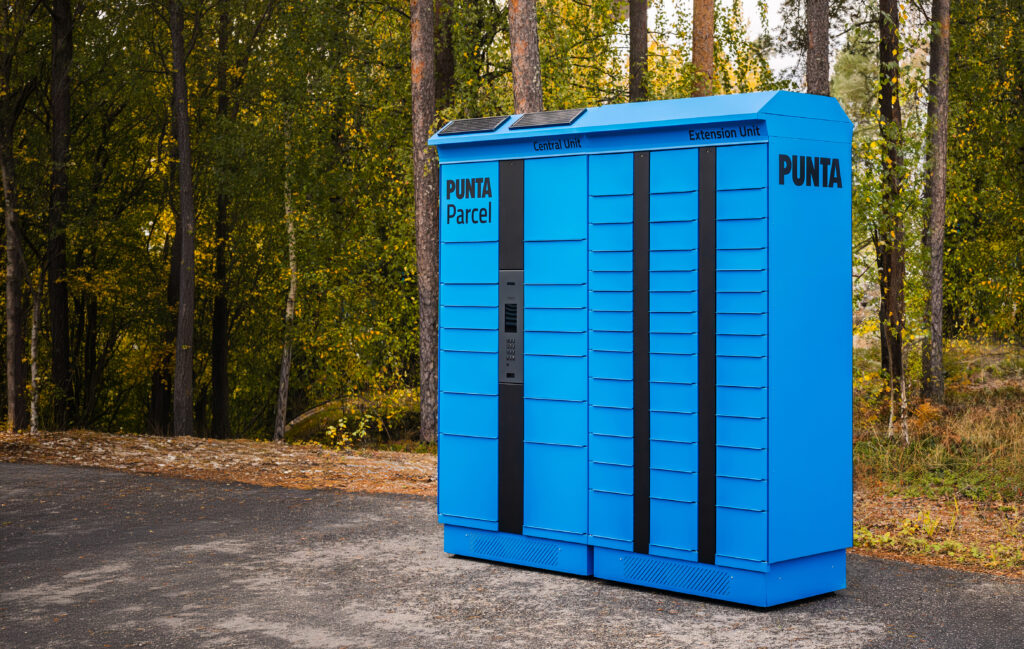
Central Unit and Extension Units
The Central Unit runs the electronics, the connectivity and the interface: the intelligence layer of the installation. It can run on its own as a complete, standalone locker point, or it can carry up to four Extension Units, each adding pure locker capacity without adding a second control layer.
A lot of competing hardware requires new control logic for every expansion. Punta’s doesn’t. That is the difference between a network that compounds and one that just accumulates cost.
Capacity should follow the location, not a factory default
Locker size and count aren’t fixed at manufacturing. They’re a decision made per site. A logistics hub can be fitted with larger compartments built for bulk and oversized loads, while a low-traffic location can stay lean with just a handful of small compartments. Same platform, reconfigured, because the hardware adapts to the location, not the other way around.
The choice is clear: build a network that can flex with real demand, or build one that locks you into a footprint you’ll outgrow or overbuild within a year.
Scaling the network is an addition, not a redesign
Traditional locker expansion means a new hardware cycle, new wiring, a new install. With Punta, it’s one of two moves: add Extension Units to an installation already live, or place a new Central Unit at a new site connecting it into the same management platform running every other location.
Why this matters for carriers and operators right now
Getting the size wrong at installation is expensive either way. Overbuild, and capacity sits unused. Underbuild, and the network hits its ceiling just as demand is proving itself. Modularity removes that bet: a location can start at the size that makes sense today and grow by adding Extension Units as real demand confirms itself, instead of locking in a guess for the next five years.
The networks that win the next phase of OOH aren’t the ones with the most lockers. They’re the ones built to reconfigure faster than demand shifts under them. Punta’s system was built on exactly that logic.
Get in touch
If you want to discuss what a modular locker network could look like for your operations, reach out to Anssi.
Anssi Suominen
CCO, Punta Oy
anssi.suominen@punta.fi