
How to choose a gas cylinder vending machine: a buyer’s checklist
A gas cylinder vending machine does two jobs for an LPG distributor or retailer. It sells gas around the clock, and it holds part of your cylinder pool: it hands out full cylinders, takes empties back and determines how often it has to be refilled. How well it does both, together with the cost of installing and running it, sets how quickly a network of machines pays for itself.
Below are the five points to compare suppliers on, the questions to ask and what a good answer looks like.
In short
- Compare the total cost of ownership, not the unit price alone.
- Check how well each machine sells and how well it protects your cylinder pool.
- Make sure it integrates with your existing systems and processes.
1. Total cost of ownership
Why it matters: Unit prices are easy to compare. The total cost of ownership is harder to see. Site preparation, refill visits, lost cylinders and manual work around each sale add up over the life of the network. Site costs also repeat at every location: groundwork, a power connection and a data line.
Ask:
- What does a site need before the unit can run?
- How long does installation take?
- Are refills planned from live stock levels or on a fixed schedule?
- What does the price include, and what costs come on top over the years?
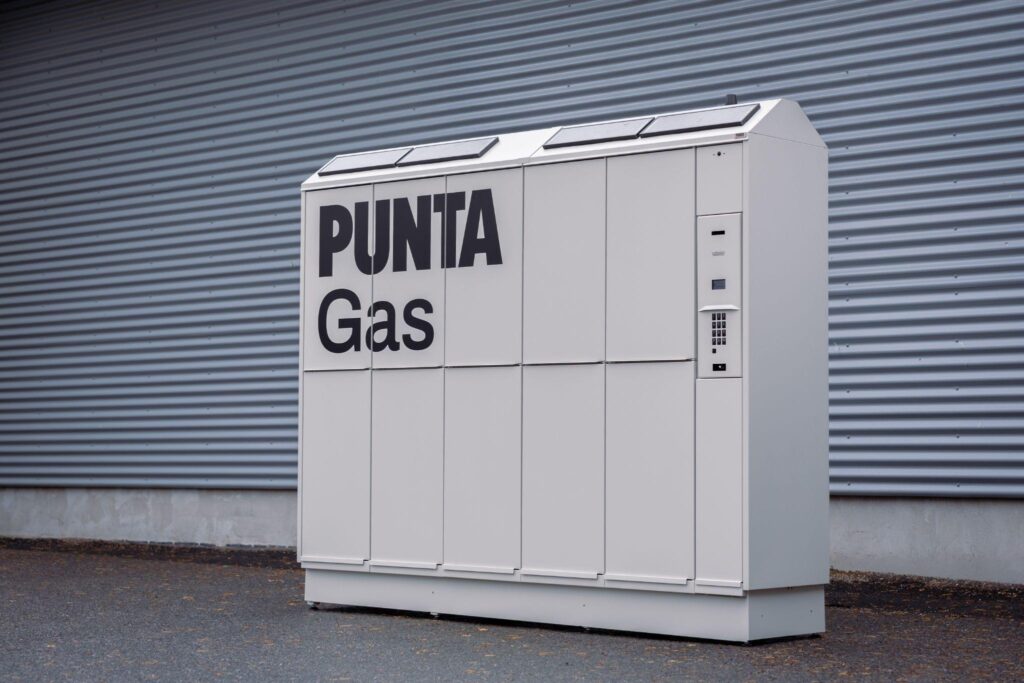
A good answer itemises both the one-off and the recurring costs, so you can compare suppliers on the same basis. With an off-grid option, there are no connections to build, so a site is ready as soon as the unit is in place. A unit that can be expanded where sales justify it lets a strong site grow. Refills planned from live stock data mean a unit is visited when it needs to be. Punta Gas installs in 15 minutes with no civil works and plans refills from real-time inventory data.
2. Sales channels
Why it matters: Distributors and retailers sell LPG through different channels, and customers want to buy in different ways. Some order online, some pay in store and some arrive at the machine with nothing but an empty cylinder. Some need a new cylinder, whether it is their first, a spare or a different size, while others exchange an empty for a full one. A machine that handles only part of this leaves the rest to your staff.
Ask:
- Can every purchase be collected from the machine, whether it was made online or in store?
- Can customers also buy and pay directly at the machine?
- Can it sell new cylinders as well as exchange empties for full ones?
A good answer covers every channel. A customer who buys online or in store receives pickup credentials, such as a PIN or QR code, by SMS, email or app, a walk-up customer pays at the unit, and the machine follows the same processes as your other sales channels. Punta Gas supports webshop and in-store sales, payment at the unit, and both new cylinder sales and exchanges.
3. Cylinder control
Why it matters: The World Liquid Gas Association notes that an LPG cylinder generally costs more than the gas it contains (WLGA). Every cylinder that does not come back is a loss to the pool, which is why every cylinder movement should be on record.
Ask:
- Does the system log every sale, collection, return and refill per compartment?
- Can every movement be traced to a transaction and a customer?
A good answer logs every movement per compartment and links it to the transaction and the customer, so you always know which cylinders went where. Punta Gas tracks every cylinder movement per compartment in this way.
4. Integration
Why it matters: Distributors and retailers already manage customers, orders and stock in their own systems, such as a webshop, an ERP and a customer register. When the machine connects to them, a purchase made in any channel reserves a cylinder and sends the pickup credentials automatically, and every collection and return updates stock where your team already works. Without integration, the same information has to be moved by hand, and that work grows with every unit you add.
Ask:
- Is there an open API with webhooks for real-time events?
- Can the platform connect to all the systems you already use, with data flowing both ways in real time?
A good answer keeps your own systems in charge of customers, orders and reporting, while the vending platform operates the machine and sends events back as they happen. Punta Gas has an open API with REST endpoints, polling and webhooks, and your systems can reserve cylinders and issue PIN codes through it.
Test it: ask for the API documentation during the tender or before you sign, and have your own developers review it.
5. Site conditions and compliance
Why it matters: Units stand unattended at forecourts, car parks and rural sites through every season, so specify for the most demanding site in your network. An off-grid unit runs on its battery and solar panels, so its power has to hold up in the conditions at your locations. A reliable mobile connection matters as much, because sales, stock data and remote management depend on it.
Ask:
- What temperature range is the unit rated for, and how long can it run off-grid?
- Which mobile technology does the unit use, and what happens if coverage drops?
- What is the security rating, such as RC2 under EN 1627?
- How does the design meet the European Accessibility Act?
A good answer states the temperature range, off-grid operating time, security rating and accessibility features in writing, uses a current mobile technology made for machines, such as LTE-M, and keeps customer access working if the connection drops. Punta Gas runs off-grid for up to 5 years, operates from −30 °C to +70 °C, uses 4G LTE-M and keeps PIN access working during network outages. It carries an RC2 security rating, and its Braille keypad and audio guidance address European Accessibility Act requirements.
Get in touch
Comparing suppliers? Start with the total cost of ownership.
Read more about Gas Cylinder Retail, or talk to our team.
Anssi Suominen
CCO, Punta Oy
anssi.suominen@punta.fi